
Think about it. Millions can’t apply for jobs, see a doctor, or complete their education because they lack reliable internet access. It’s a reality many still face today. Digital equality is not a distant goal. It’s an urgent necessity that affects lives right now.
Quick Summary
This article examines strategies for achieving digital equality and fostering an inclusive internet. Next, we’ll examine the digital divide and uncover who faces the greatest barriers. Then, we’ll outline practical strategies that communities, educators, and organizations can apply. You’ll find simple steps to track your progress and maintain momentum. Each action moves you closer to universal digital participation. Finally, we’ll see how collaboration makes a real difference. With the right policies and partnerships, it can drive lasting change.
Path to Universal Digital Participation
Modern life is deeply intertwined with the internet. Yet, access remains unequal. This gap limits opportunities and prevents millions from fully participating in society. It is a challenge that calls for attention and action.
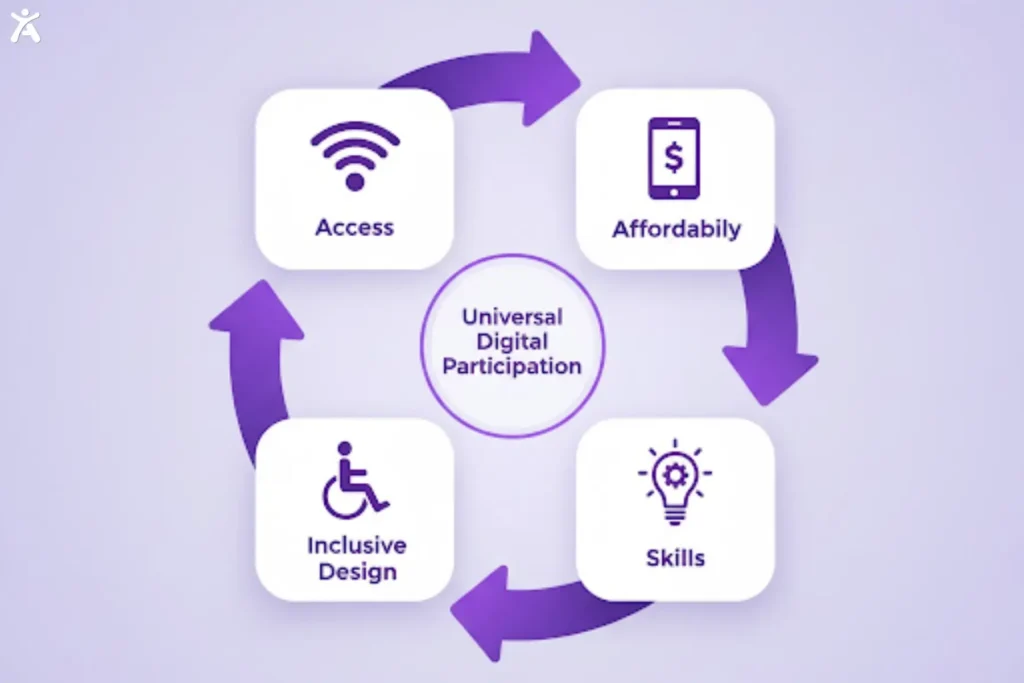
Building digital equality takes more than just providing internet access. It calls for a comprehensive approach. The approach tackles affordability, digital literacy, suitable devices, and inclusive design. Each part plays a key role in bridging the gap. This article provides educators, marketers, and community leaders with a guide to creating meaningful change.
Connectivity vs Digital Divide
The digital revolution promised unprecedented opportunities for connection, learning, and economic advancement. High-speed internet enables remote work, telemedicine, online education, and civic engagement. These technologies have transformed how we communicate, learn, and conduct business.
The digital divide shows a clear contrast. Some communities thrive online, but others stay disconnected. Rural areas often lack broadband infrastructure. Low-income households struggle to afford the monthly fees of internet service providers. People with disabilities encounter websites that ignore accessibility standards.
Digital Equality and Equity
Digital equality means that everyone has equal access to and benefits from digital technologies. The concept applies to all people, regardless of location, income, ability, or background. It is closely related to digital equity, which recognizes that different communities need varying levels of support to achieve equal outcomes.
An inclusive internet goes beyond basic access by ensuring that digital resources, tools, and platforms are available to everyone. Inclusive design supports people who use screen readers, individuals with mobility challenges, and communities where English is not the primary language.
Digital Inclusion as the Key Challenge
Digital inclusion has become a matter of social justice and human rights. Without internet access and digital skills, people struggle to find jobs. They also can’t access government services or participate in democratic activities. Public libraries and community centers help close gaps. However, they can’t fix systemic inequities by themselves.
The COVID-19 pandemic highlighted these disparities dramatically. Students without broadband connections fell behind in remote learning. Workers without digital devices lost employment opportunities. Healthcare became harder to access for those lacking digital navigation services.
Tools like Accessify can help bridge digital accessibility gaps, ensuring websites and online resources are usable by people with disabilities, even as other digital inequities persist.
Breaking Down the Digital Divide

The digital divide isn’t a single problem. It’s a complex web of interconnected challenges that requires multifaceted solutions.
A Multifaceted Challenge for Digital Equality
Many discussions about digital equality focus solely on broadband deployment and internet connectivity. While broadband access matters, true digital inclusion requires four essential elements:
Infrastructure and Access: Get reliable and affordable high-speed internet through fiber-optic networks, municipal broadband, or other community-based solutions.
Affordable Devices: Computers, tablets, and smartphones that enable full participation in digital life.
Digital Literacy Training: Skills to navigate online platforms safely, evaluate information critically, and use digital tools effectively for work and education.
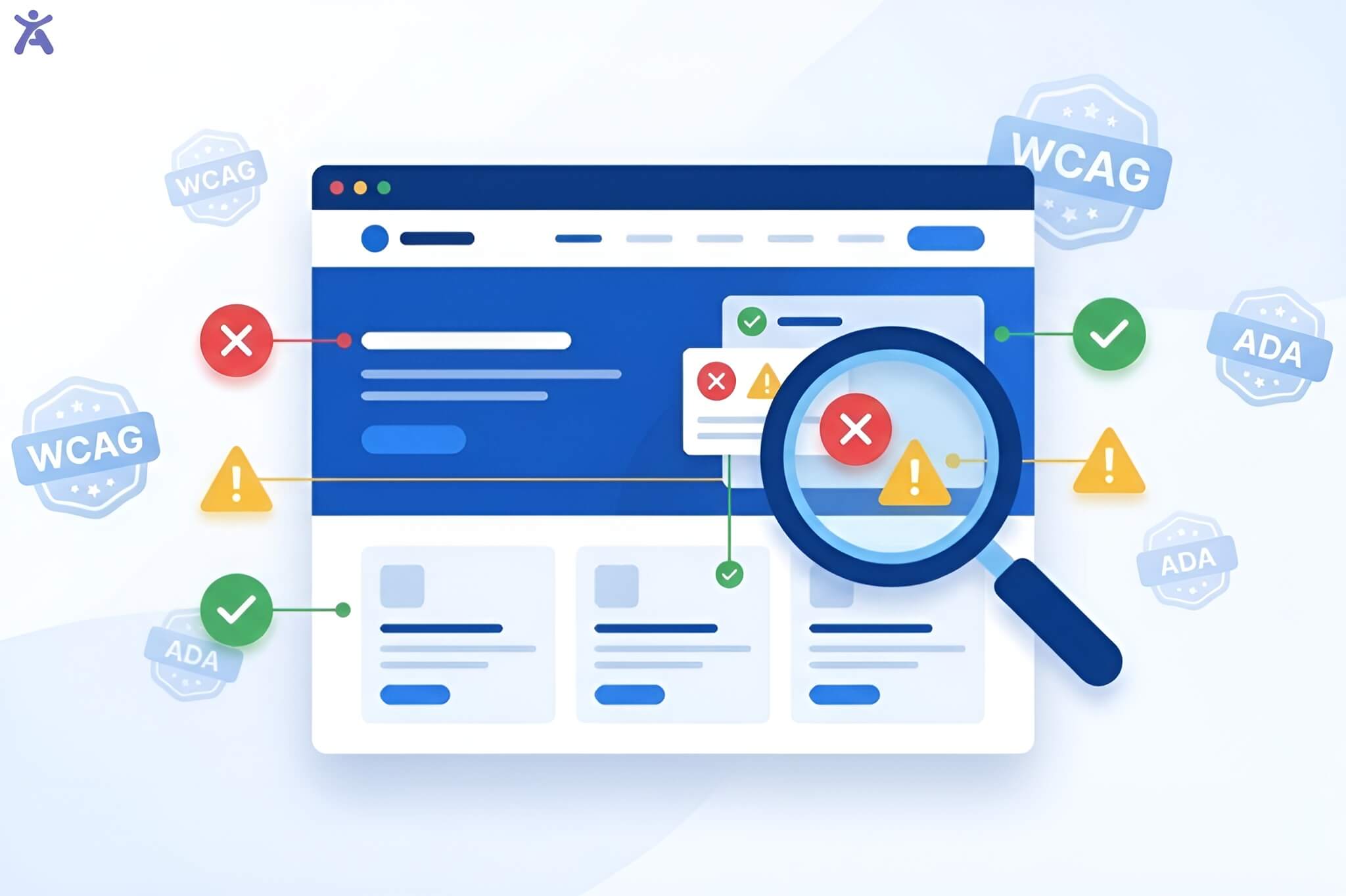
Accessible Design: Websites and apps should adhere to the Web Content Accessibility Guidelines (WCAG) to ensure accessibility. They need to use alt text for images, support assistive technologies, and apply responsive design principles.
How Inequity Harms Communities
Communities without adequate digital resources face compounding disadvantages. Students in areas with slow internet often struggle to complete their homework. They also find it challenging to research colleges and develop the technical skills that employers seek. Small businesses often struggle to compete online, which limits their economic growth.
The National Telecommunications and Information Administration reports that rural broadband remains underdeveloped in many parts of the country. This shortage persists despite the Telecommunications Act of 1996, which aimed to achieve universal service. Although state governments have increased investment, significant access gaps persist.
Digital exclusion also affects community health. Telemedicine requires reliable internet access and basic digital skills. Without these, people miss preventive care. They struggle to manage chronic conditions and face worse health outcomes.
Intersectional challenges for vulnerable populations.
The digital divide disproportionately impacts specific populations who face overlapping barriers.
- Rural communities often lack the broadband infrastructure that urban areas take for granted.
- Low-income households often struggle to afford the monthly fees of internet service providers and access to adequate digital devices.
- Older adults may lack digital literacy or confidence in using new technologies.
- People with disabilities encounter websites that ignore accessibility tools and standards, like Section 508 or the Americans with Disabilities Act requirements. Using platforms like Accessify can help identify and fix accessibility gaps, making digital spaces more inclusive for all users.
- Non-English speakers find fewer resources available in their languages.
- Tribal communities face unique connectivity challenges related to sovereignty and infrastructure.
These populations do not exist in isolation. A low-income older adult in a rural area faces multiple challenges. These barriers need coordinated solutions.
The Core Pillars of Digital Equality
Achieving digital equality requires strong foundations across five key areas.
1. Universal Broadband Access:
Every household needs affordable, reliable high-speed internet. Expand broadband infrastructure to underserved areas. Support community broadband initiatives. Treat internet access as a public utility, not a luxury.
2. Device Access to Devices:
People need access to the right digital devices, including not only smartphones but also fully functional computers. Programs that provide device lending, subsidies, and refurbished equipment help close the digital access gap.
3. Digital Literacy and Skills Training:
Digital literacy programs must meet people where they are. They need to provide instruction for both beginners and advanced users. Adult education programs, public libraries, and digital inclusion community centers provide crucial support. Programs like the Cybernauts program demonstrate how structured digital skills training transforms lives.
4. Accessible Design Standards:
Digital equality requires universal design principles. Websites must feature:
- Proper headings
- Clear alt text for images.
- Keyboard navigation
- Screen reader compatibility
The Web Content Accessibility Guidelines and the European Accessibility Act provide frameworks that work for everyone.
5. Sustained Funding and Investment:
Digital inclusion programs need reliable, long-term funding. Federal grant funding, state governments, community foundations, and public-private partnerships all play essential roles in sustaining momentum.
Creating an Inclusive Digital Ecosystem
Moving from principles to practice requires coordinated action across multiple sectors. Here’s how communities can build more inclusive digital ecosystems.
Policy and Advocacy for Digital Inclusion
Policy advocacy creates the regulatory and funding frameworks that enable digital equality. The bipartisan Digital Equity Act shows a strong federal commitment. It offers resources for digital inclusion strategies. Effective policy advocacy includes:
- Supporting legislation that funds broadband infrastructure in underserved areas.
- Advocating for internet affordability programs that reduce costs for low-income households.
- Pushing for stronger standards that enforce compliance with the Web Content Accessibility Guidelines.
- Ensure that digital equity is incorporated into education, healthcare, and economic development policies.
The Digital US Coalition and similar organizations provide models for coordinated advocacy efforts. Senator Patty Murray and Senator Portman’s work on the Digital Equity Act shows how bipartisan approaches can advance digital inclusion.
Collaborative Solutions
No single organization can solve digital inequality alone. Public-private partnerships leverage the strengths of government agencies, private companies, nonprofits, and community organizations to achieve shared goals. Successful collaborative models include:
- Internet service providers are partnering with local governments. They aim to bring broadband access to underserved neighborhoods.
- Technology companies are donating refurbished devices to community digital inclusion programs.
- Public libraries host digital literacy training sessions taught by digital inclusion practitioners.
- Community foundations support digital navigator programs that offer personalized assistance.
- Businesses provide space and connectivity for community technology centers.
The community toolbox approach emphasizes local ownership and sustainability. When communities help design and run digital inclusion programs, those efforts truly meet real needs.
Leveraging Technology for Greater Inclusion
Technology itself can advance digital equality when designed thoughtfully. Mobile learning platforms make education accessible to people with limited computer access. AI and machine learning drive digital skills programs. They adapt to each person’s learning style.
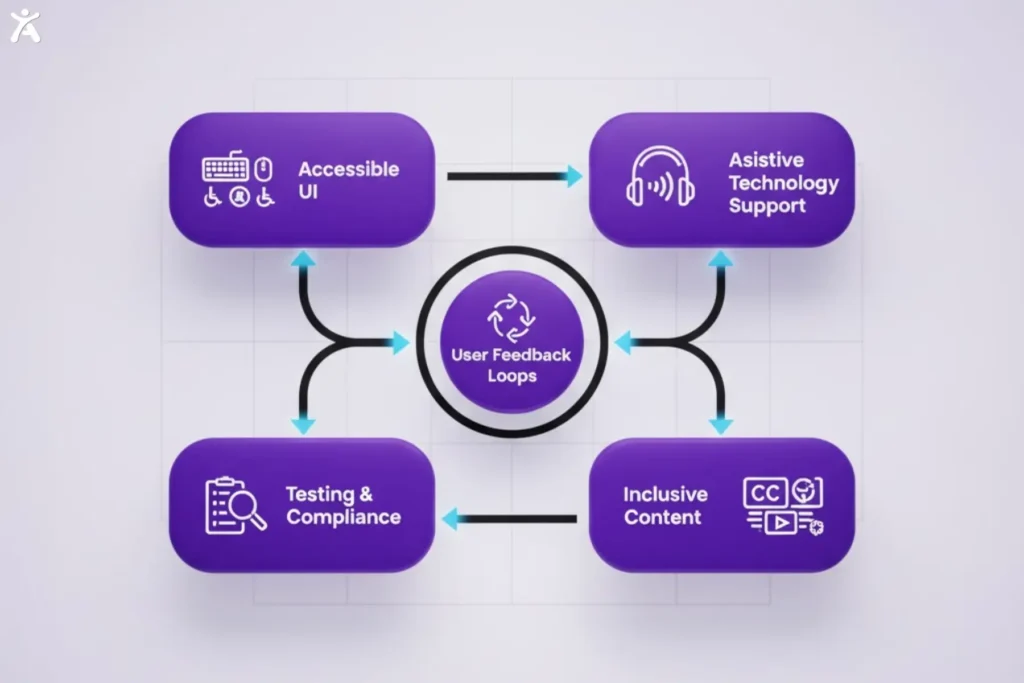
Virtual reality creates immersive training environments. Assistive technologies enable persons with disabilities to navigate digital spaces effectively. Simple tools improve digital content accessibility. Clear navigation, readable fonts, and video captions are key, ensuring content is usable for diverse abilities and allowing users with various impairments to engage seamlessly.
The key is designing with inclusion from the start rather than adding accessibility features as an afterthought. Universal design principles create better experiences for everyone.
Funding Digital Equality
Building digital equality requires sustained investment across multiple areas:
- Infrastructure: Expanding fiber-optic networks and broadband deployment in rural and underserved urban areas.
- Subsidies: Making internet service and devices affordable through programs that reduce costs for low-income households.
- Training: Funding digital literacy training programs through public libraries, adult education centers, and community organizations.
- Support Services: Maintaining digital navigator programs that provide ongoing assistance.
- Innovation: Supporting research into new technologies and approaches that advance digital inclusion.
Federal funding sources include programs administered by the National Telecommunications and Information Administration. State governments increasingly allocate resources specifically for digital equity initiatives. Private philanthropy and corporate social responsibility programs add essential support.
Tracking Progress Toward True Digital Equality
How do we know if digital inclusion efforts are working? Measuring digital inclusion requires tracking both access and outcomes:
Access Metrics:
- Percentage of households with a broadband connection at adequate speeds.
- Device ownership rates across different demographic groups.
- Availability of public internet access points, such as public libraries.
- Affordability indicators compare internet costs to household income.
Outcome Metrics:
- Digital skills levels are measured through standardized assessments.
- Usage of digital tools for education, employment, healthcare, and civic participation.
- Economic indicators, like online business creation and digital employment,
- Educational outcomes for students in digital inclusion programs.
- Health outcomes related to telemedicine use.
The digital inclusion community created frameworks for consistent measurement. These frameworks enable the comparison of different communities and the tracking of progress over time.
Internet Universality Framework for Digital Equality
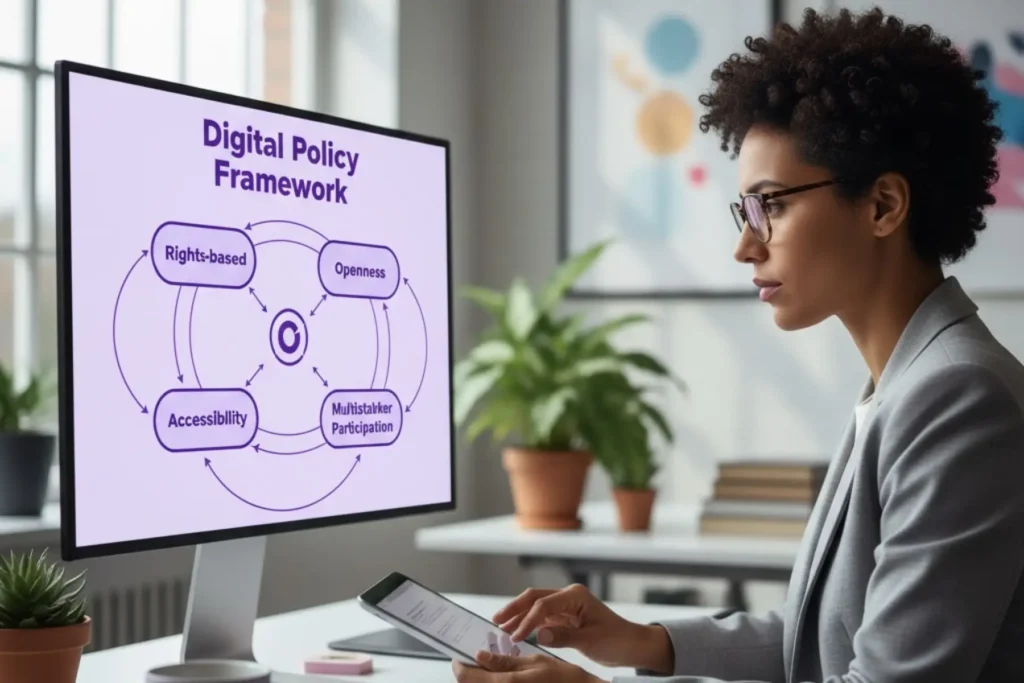
UNESCO’s Internet Universality framework helps assess if digital ecosystems truly serve all. The framework evaluates internet access and governance across four dimensions:
- Rights-based: Does the internet respect human rights, including freedom of expression and privacy?
- Open: Are platforms, content, and technologies accessible without artificial barriers?
- Accessible: Can everyone participate regardless of ability, language, location, or economic status?
- Multi-stakeholder: Do diverse voices shape internet governance and development?
This framework helps communities gain a broader perspective. It reveals whether digital transformation fosters equity or exacerbates inequality. The goal is straightforward: to ensure that progress benefits everyone, not just a select few.
Continuous Evaluation for Digital Inclusion
Digital inclusion isn’t a one-time project. It is an ongoing process that requires continuous evaluation. Ongoing advocacy and evaluation reveal what works and what needs improvement.
Effective evaluation includes:
- Collecting quantitative data on usage, skills development, and outcomes.
- Gathering qualitative feedback from program participants about their experiences.
- Analyzing which populations remain underserved despite intervention efforts.
- Sharing findings with digital inclusion practitioners and policymakers.
- Adapting programs based on evidence and community input.
Communities should celebrate successes while honestly acknowledging persistent gaps. This learning orientation enables continuous improvement. It ensures resources are directed where they’ll have the greatest impact.
Final Thoughts
Digital equality begins with intentional action, and everyone has a role to play in achieving it. As essential services move online, access gaps can leave students, job seekers, and communities at a disadvantage. Expanding broadband, making devices affordable, and strengthening digital literacy all support a more inclusive digital environment. Clear accessibility standards and policies, including the Digital Equity Act, guide this progress.
Build digital inclusion into every project and decision. Whether you are an educator, marketer, business leader, or policymaker, prioritizing accessibility ensures technology works for everyone. Achieving a truly equitable digital future requires ongoing effort, learning, and shared responsibility.
FAQs
It refers to the fair access to technology, the internet, and digital skills for all. It connects people, supports learning, and enables communities to share opportunities and resources regardless of location or socioeconomic status.
Global digital equality requires collaboration from governments, educators, and tech leaders. Providing affordable devices and training through Accessify supports efficient monitoring to detect barriers, ensuring no one is left behind online.
Examples include free Wi-Fi in schools, community computer labs, accessible technology for users with varying abilities, and online courses for remote learners. These initiatives ensure knowledge and opportunities reach everyone.
Inclusive technology improves education by ensuring equitable access to devices and online resources. This equitable access supports learning, sparks creativity, and promotes inclusion, helping all students succeed in classrooms and beyond.
Technological equality bridges gaps in education, healthcare, and employment. Tools like Lighthouse and Accessify support accessibility checks to maintain inclusive technology use, helping people leverage digital opportunities effectively.