

1. What Is the European Accessibility Act?
The European Accessibility Act (Directive 2019/882) is EU legislation requiring that a wide range of products and services including websites, mobile apps, and e-commerce platforms meet accessibility standards set out in EN 301 549.
The EAA was adopted in 2019 and gave businesses a six-year transition period. That transition period ended on 28 June 2025. Enforcement is now active across EU member states.
The EAA’s digital scope covers:
E-commerce websites product pages, checkout, customer account areas
Banking and financial service websites online banking, investment platforms
Transport websites airline and train booking, ticketing platforms
Streaming services video-on-demand, audio content platforms
Telecommunications services with digital customer interfaces
Operating systems and hardware relevant for software companies
In plain terms: if you operate a consumer-facing digital service and European customers can access it, the EAA is relevant to you.
2. EAA Enforcement: What Happened on 28 June 2025?
28 June 2025 was the application date the date by which all in-scope products and services were required to meet EAA accessibility requirements. EU member states were required to have transposed the Directive into national law and established enforcement bodies.
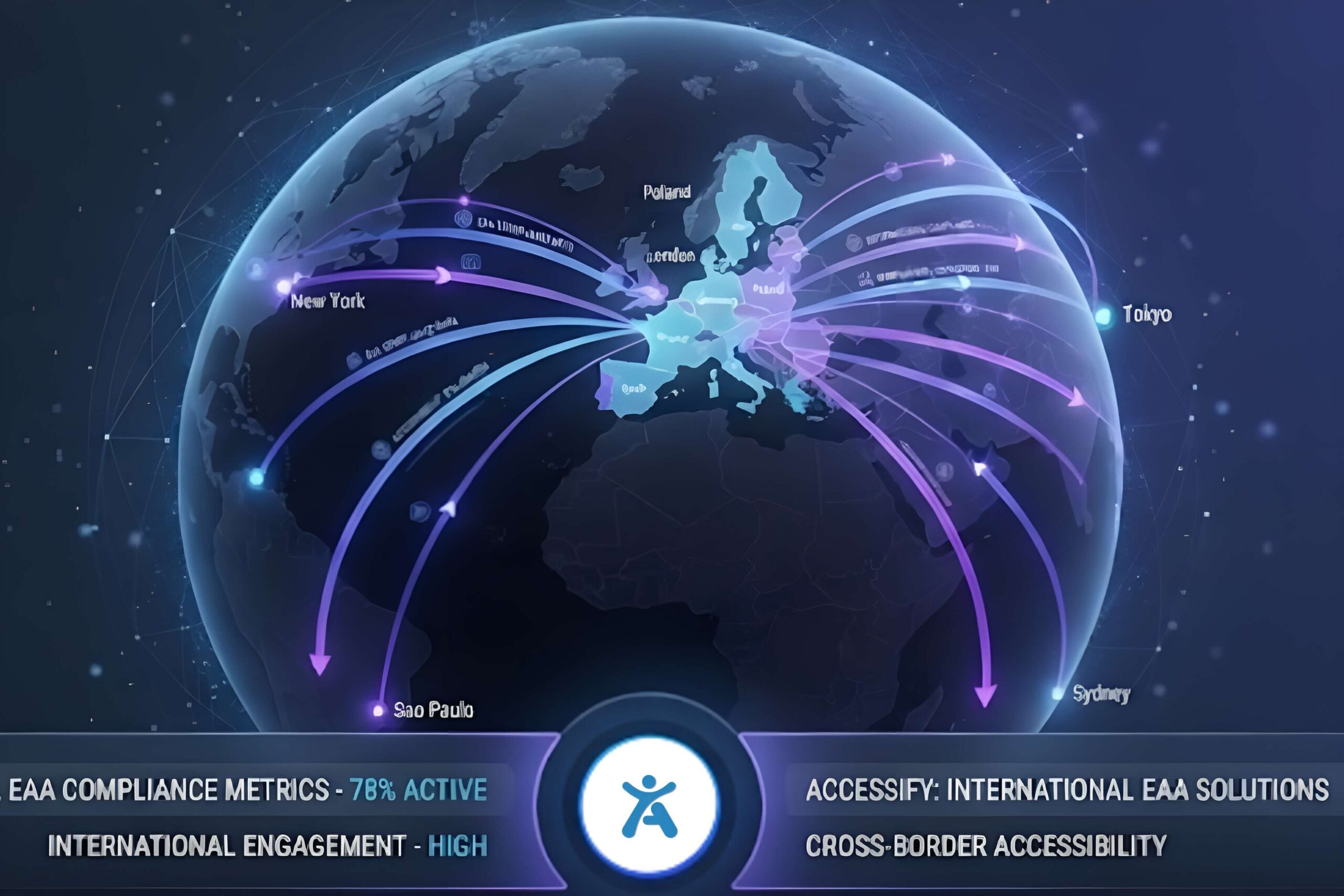
What enforcement looks like in practice:
Each EU member state has designated a national market surveillance authority responsible for EAA enforcement. In practice, enforcement actions are being initiated through:
- Complaints by users or disability advocacy organisations the most common trigger
- Proactive market surveillance national authorities spot-checking high-profile digital services
- Competitor complaints businesses can report non-compliant competitors to national authorities
For businesses found non-compliant, enforcement typically begins with a remediation notice requiring correction within a specified period, followed by fines for continued non-compliance.
There is no EAA grace period for new enforcement. The deadline was June 2025 actions filed after that date are valid.
3. Does the EAA Apply to Non-EU Businesses?
Yes with conditions. This is the most misunderstood aspect of EAA compliance and it directly affects US, UK, Canadian, Australian, and global e-commerce businesses.
The EAA applies based on where the service is provided, not where the business is incorporated. If your website:
- Sells products or services to consumers in EU member states
- Is available in EU languages (e.g., German, French, Spanish)
- Prices goods in Euros
- Has EU-based delivery addresses as options
then the EAA almost certainly applies to your digital storefront.
Practical examples:
- A US Shopify store shipping to Germany → EAA applies to the website
- A UK SaaS company with European customers → EAA applies to the customer portal
- An Australian tour operator with French and German website versions → EAA applies
- A Canadian business that only ships within Canada → EAA likely does not apply
UK-specific note: Post-Brexit, the UK is not subject to the EAA directly. However, the UK Equality Act 2010 imposes comparable obligations for websites accessible to UK users. Businesses simultaneously serving EU and UK markets should treat WCAG 2.1 AA compliance as meeting both.
4. What Websites and Digital Products Are Covered?
The EAA covers services provided to “consumers” meaning end-users who are not acting in a professional or trade capacity. B2B-only platforms have more limited exposure, but mixed B2B/B2C platforms fall under the full EAA scope.
Specifically covered digital services:
| Service Type | EAA Coverage |
|---|---|
| E-commerce (B2C) | ✅ Full scope |
| Online banking and financial services | ✅ Full scope |
| Transport booking websites (flights, trains, buses) | ✅ Full scope |
| Video-on-demand services | ✅ Full scope |
| Mobile applications (iOS, Android) | ✅ Full scope |
| Consumer-facing SaaS platforms | ✅ Likely full scope |
| B2B-only platforms (no consumer access) | ⚠️ Limited verify with legal counsel |
| Government and public sector websites | ❌ Covered by separate EU Web Accessibility Directive |
Note on the Web Accessibility Directive: EU public sector websites (government, universities, publicly funded organisations) are already subject to the EU Web Accessibility Directive (2016/2102), which has been enforced since 2020–2021. The EAA extends comparable obligations to the private sector.
5. What Technical Standard Does the EAA Require?
The EAA mandates conformance with EN 301 549 the European harmonised standard for digital accessibility.
EN 301 549 is built on a foundation of WCAG 2.1 Level AA (Web Content Accessibility Guidelines), with additional requirements specific to software, hardware, and telecommunications services.
For most websites and web applications, EN 301 549 compliance is functionally equivalent to WCAG 2.1 AA compliance. Meeting WCAG 2.1 AA puts your website in conformance with the web-content portions of EN 301 549.
Key WCAG 2.1 AA requirements for websites:
- All images have meaningful alt text (SC 1.1.1)
- Videos have captions and audio descriptions (SC 1.2.3, 1.2.5)
- Text has a minimum 4.5:1 contrast ratio (SC 1.4.3)
- Content reflows at 400% zoom without loss of functionality (SC 1.4.10)
- All functionality is operable by keyboard (SC 2.1.1)
- Skip navigation is present (SC 2.4.1)
- Focus is visible on all interactive elements (SC 2.4.7)
- Forms have visible labels and clear error messages (SC 3.3.1, 3.3.2)
- Language of the page is identified in HTML (SC 3.1.1)
6. EN 301 549 vs WCAG 2.1 vs WCAG 2.2: What Is the Difference?
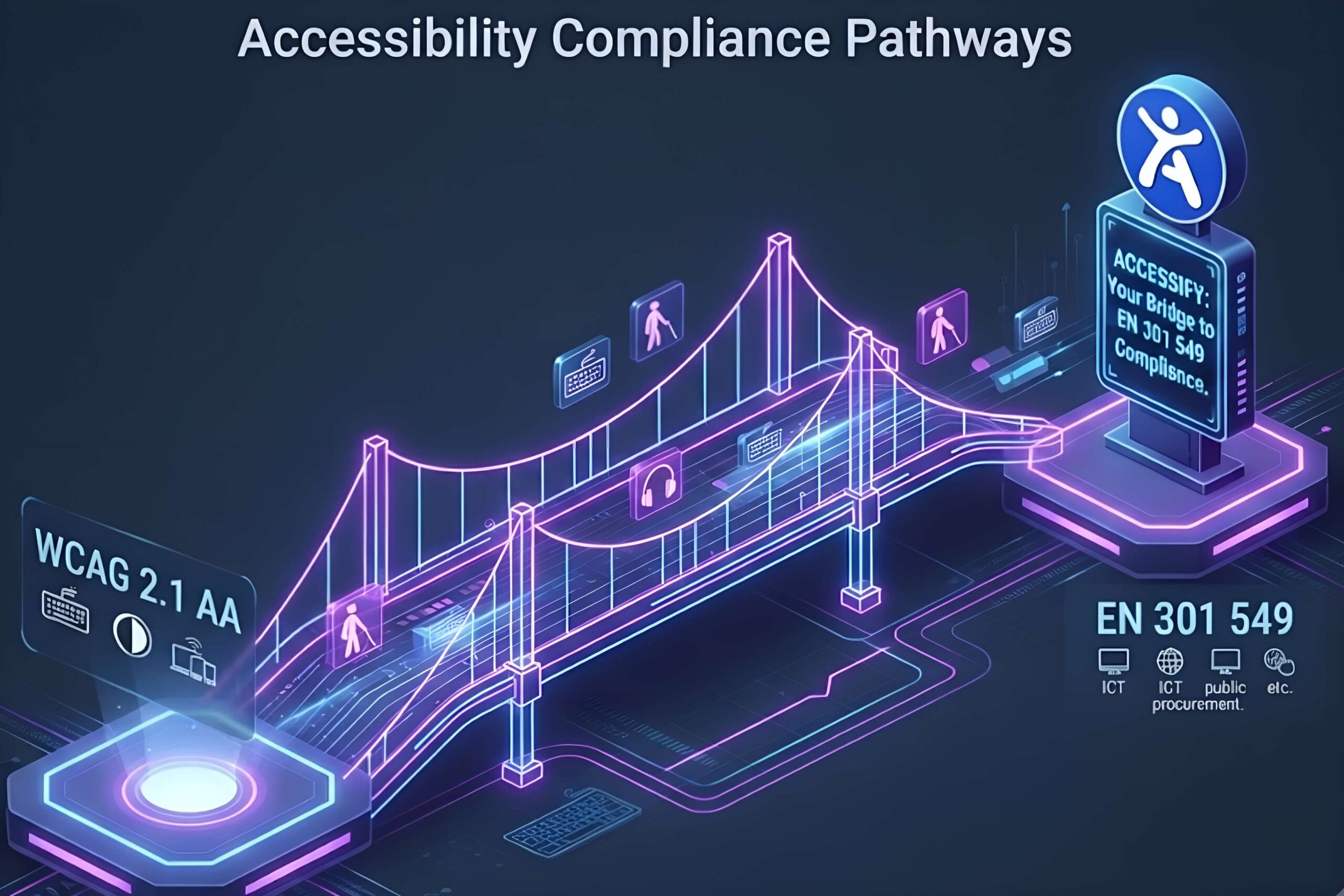
Understanding these three standards and their relationship helps businesses prioritise compliance efforts:
| Standard | Origin | Scope | Status |
|---|---|---|---|
| WCAG 2.1 AA | W3C (global) | Web content only | Baseline for EAA (EN 301 549) |
| EN 301 549 | ETSI/CEN (European) | Web + software + hardware | Legal requirement under EAA |
| WCAG 2.2 AA | W3C (global) | Web content only | Current best practice; not yet in EN 301 549 |
The practical advice:
- For EAA compliance: achieve WCAG 2.1 AA
- For future-proofing and best practice: target WCAG 2.2 AA (EN 301 549 will likely be updated to reference WCAG 2.2)
- For US ADA compliance: same WCAG 2.1 AA target applies
There is no cost to building for WCAG 2.2 when the additional criteria are relatively minor. Accessify supports WCAG 2.2 AA at the widget layer, putting you ahead of the minimum EAA requirement.
7. EAA Exemptions: Who Is Excluded?
The EAA includes a micro-enterprise exemption for service providers. Specifically:
A micro-enterprise is defined as a business with:
- Fewer than 10 employees, AND
- Annual turnover or balance sheet of €2 million or less
Micro-enterprises providing services (not products) may be exempt from some EAA requirements. However, this exemption:
- Does not apply to businesses selling physical products
- Does not apply to businesses providing e-commerce services
- Varies in interpretation across EU member states
- Does not provide immunity from national disability discrimination laws
In practice, any business generating meaningful EU revenue should not rely on the micro-enterprise exemption as a compliance strategy. The cost of EAA compliance is far lower than the cost of enforcement.
8. EAA Enforcement: Fines and Penalties
EAA enforcement is determined by each member state. Penalties vary, but the range across early-adopter member states gives a clear picture:
- Germany (BFSG): Enforcement through market surveillance authorities; fines for systematic non-compliance
- France (Loi du 11 février 2005): Administrative penalties plus the right of users to sue for discrimination
- Netherlands: Compliance notices with deadlines; fines for ongoing non-compliance post-notice
- Italy: Administrative fines up to €80,000 for significant violations
Beyond direct fines, non-compliant businesses face:
- Being barred from government procurement contracts in EU member states
- Reputational damage in privacy and compliance-conscious European markets
- Private right of action claims from disabled users in jurisdictions that permit them
The reputational risk in the EU where GDPR enforcement has established that regulatory action against digital services is real and public is arguably greater than the direct fine risk for most businesses.
9. How to Make Your Website EAA Compliant

First Step: Determine if the EAA applies to you Do you have EU customers, ship to EU addresses, price in Euros, or have EU-language pages? If yes, proceed.
Second Step: Run a WCAG 2.1 AA audit Use the WAVE browser extension, Google Lighthouse’s accessibility audit, or a professional audit service to identify current gaps. Focus on: images, forms, keyboard navigation, colour contrast, captions, and heading structure.
Third Step: Fix the critical failures first Prioritise:
- Missing alt text on images
- Unlabelled form inputs
- Keyboard navigation failures
- Colour contrast failures below 4.5:1
Fourth Step: Deploy an accessibility widget for automated remediation After addressing critical manual fixes, deploy Accessify to handle the automated compliance layer contrast adjustments, focus management, skip navigation, and ARIA landmark injection.
Fifth Step: Document your compliance efforts Under EN 301 549, maintaining an Accessibility Statement on your website is a requirement. This statement must:
- State the standard you are conforming to (WCAG 2.1 AA / EN 301 549)
- List known non-conformances and planned remediation timeline
- Provide a contact mechanism for accessibility issues
- Be updated regularly
Sixth Step: Establish a compliance monitoring process Run quarterly audits. Review your Accessify dashboard monthly. Test keyboard navigation and screen reader compatibility after any major site update.
10. How Accessify Supports EAA Compliance
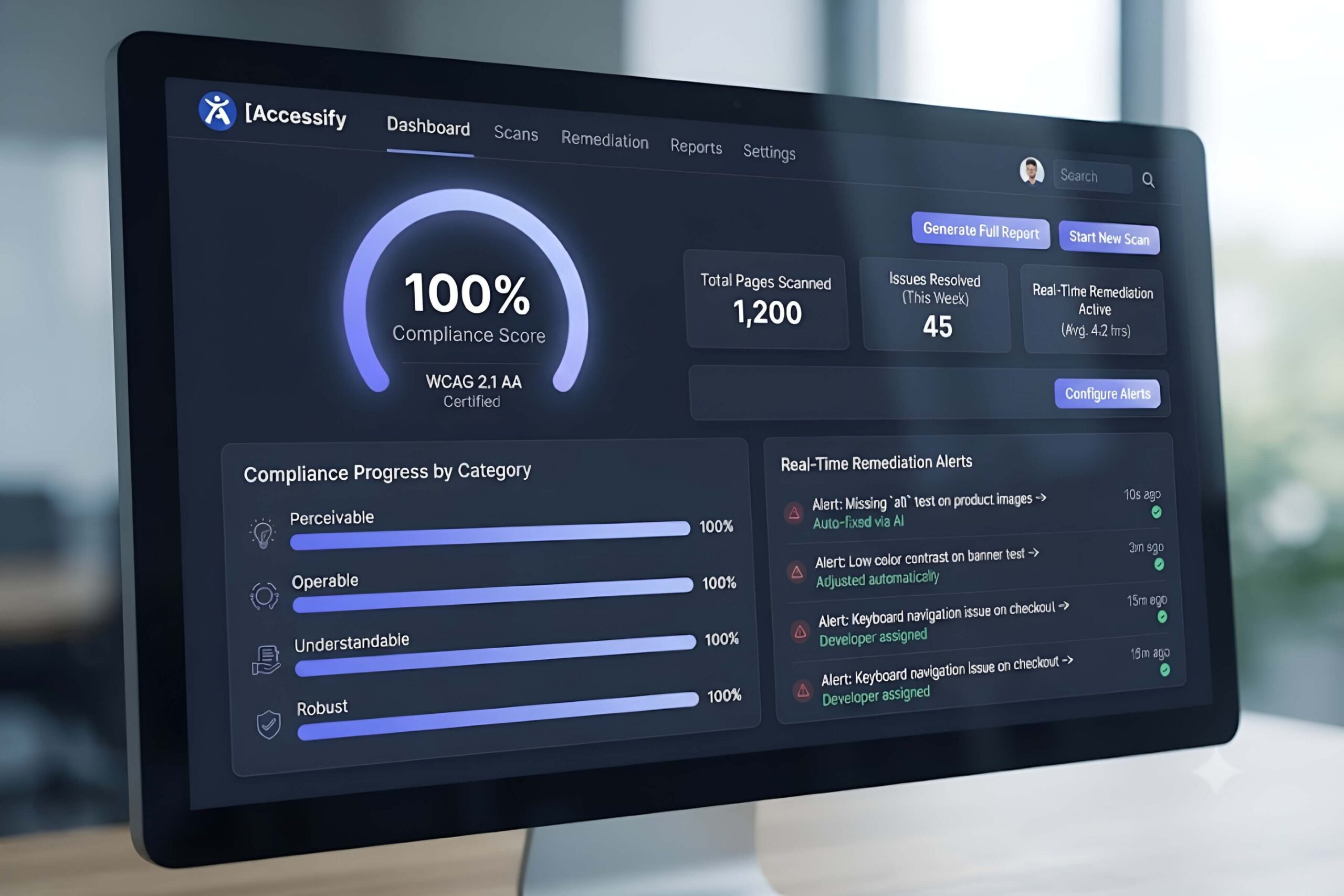
Accessify is an AI-powered web accessibility widget that supports EN 301 549 / WCAG 2.1 AA and WCAG 2.2 AA compliance making it directly applicable to EAA requirements.
Specifically, Accessify addresses:
Perceivable (WCAG Principle 1):
- Colour contrast profile switching (high contrast, monochrome, inverted)
- Text size and spacing adjustments
- Image description enhancement where alt text is present
Operable (WCAG Principle 2):
- Keyboard navigation focus management
- Skip navigation injection
- Keyboard-accessible widget interface
- Motion reduction option
Understandable (WCAG Principle 3):
- Reading guide and focus mask for cognitive accessibility
- Dyslexia-friendly font option
- Link highlighting for navigational clarity
Robust (WCAG Principle 4):
- ARIA landmark role injection for standard page components
- Screen reader optimisation mode
- Compatibility testing across NVDA, JAWS, VoiceOver, and TalkBack
Compliance Dashboard: Accessify’s dashboard provides a real-time WCAG conformance score and flags issues requiring manual developer attention enabling you to maintain and update your Accessibility Statement accurately.
Accessify is available in a language-localised version appropriate for EU-facing websites, supporting the EAA’s requirement that accessibility information be provided in the language of the service.
11. EAA vs ADA: Key Differences for International Businesses
If you are a US business managing both ADA and EAA compliance, this comparison clarifies what is different and what is shared:
| Aspect | ADA (US) | EAA (EU) |
|---|---|---|
| Technical standard | WCAG 2.1 AA (courts) | EN 301 549 (WCAG 2.1 AA) |
| Who enforces | DOJ + private litigants | National market surveillance authorities |
| Main enforcement mechanism | Federal lawsuits | Administrative action + fines |
| Applies to non-US businesses | No (US-facing sites only) | Yes (EU-facing sites, any domicile) |
| Accessibility Statement required | No (best practice) | Yes (mandatory for EAA) |
| Exemption for small businesses | No federal exemption | Micro-enterprise partial exemption |
| Compliance documentation value | High (courts view favourably) | Required under EN 301 549 |
The key practical insight: WCAG 2.1 AA compliance satisfies both the ADA (the standard courts apply) and the EAA (via EN 301 549). A single compliance investment covers both regulatory regimes. For businesses with both US and EU customers, a tool like Accessify that targets WCAG 2.2 AA provides compliance headroom for both frameworks.
Conclusion
The European Accessibility Act is not a future regulation it is live, it is enforced, and it applies to your website if European customers can access it. The combination of WCAG 2.1 AA manual remediation and an Accessify widget deployment gives you a defensible, documented, and maintainable path to EN 301 549 compliance.
The first-mover advantage is significant. Most competitors in your market have not yet addressed EAA compliance. Getting compliant now positions your business as the responsible choice for European customers and protects you from enforcement actions that are already being initiated.
Start your Accessify free trial and achieve EAA compliance today →
FAQ
Yes, if those businesses provide products or services to EU consumers. The EAA applies based on where the service is offered, not where the business is registered. US, UK, and other non-EU businesses selling to EU customers must comply.
The EAA requires conformance with EN 301 549, which is built on WCAG 2.1 Level AA for web content. Achieving WCAG 2.1 AA covers the web-content requirements of the EAA.
An Accessibility Statement is a mandatory document for EAA-covered services. List known accessibility barriers and when they will be fixed, and provide a contact mechanism for users to report accessibility problems.
Businesses with fewer than 10 employees and under €2 million turnover may be exempt from certain EAA service requirements, but this exemption is narrow, varies by member state, and does not apply to e-commerce product sellers.
Yes. Accessify is an AI accessibility widget supporting WCAG 2.2 AA compliance which exceeds the WCAG 2.1 AA standard required by EN 301 549 for EAA compliance. Combined with manual fixes (alt text, form labels, captions), Accessify provides the automated remediation layer needed for a defensible EAA compliance position.